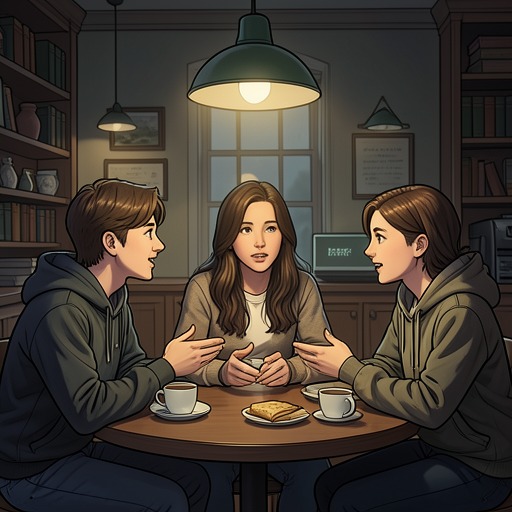
Hannah and Jessica’s falling-out and physical altercation at Monet’s
Thirteen Reasons WhyHannah and Jessica’s falling-out and physical altercation at Monet’s turns a friendship’s supposed safe haven into the site of its rupture. When Jessica confronts Hannah over Alex’s list and the rumors surrounding it, Hannah offers an explanation and a denial; Jessica instead hears blame, strikes her, and leaves a scar that Hannah continues to see. The scene makes the damage of rumor physical, while Hannah’s later account of the encounter reveals how badly the two friends have misunderstood one another.
From a shared refuge to confrontation
Hannah dates the rupture to a day at school when Jessica approached her in the halls and said they needed to talk. She did not specify the subject or the place, but Hannah understood that she meant Monet’s and believed she knew why. The expectation that the conversation belonged there matters: Monet’s had been a safe haven for Hannah, Jessica, and Alex, a place associated with their connection before Alex’s list divided them.
When Hannah arrived, Jessica was sitting slumped in a chair, her arms hanging at her sides. Hannah wondered whether Jessica had been waiting long enough to hope she would skip her last class and join her. Hannah sat down and reached a hand across the table, offering their familiar call, “Olly-olly-oxen-free?” The gesture attempts to reopen a channel between them, but Jessica answers not with a shared recollection or a greeting, but with the paper that has come to define their conflict.
Jessica slapped the list onto the table, pushed it across, and turned it around for Hannah. Hannah recognized it immediately: she had first read the “WHO’S HOT / WHO’S NOT” list upside down on Jimmy’s desk. She knew which side Alex had assigned her to, and Jessica, her supposed opposite, was sitting across from her at the place the three of them had once shared. The list’s blunt sorting has reorganized that friendship into positions and suspicions.
Rumors and conflicting explanations
Hannah tells Jessica that Alex did not choose her over Jessica. In Hannah’s account, Alex chose Hannah to get back at Jessica, knowing that Hannah’s name would hurt her more than anyone else’s. This explanation casts the list not as evidence of a relationship between Hannah and Alex, but as a deliberate provocation aimed at Jessica. It also makes Hannah’s place on the list part of a conflict between the other two students, a role she did not choose.
Jessica says she knows the rumors. Hannah objects to the difference between hearing a rumor and knowing it: rumors can be heard, she argues, but that does not make them true. She had hoped that moving with her family would leave old rumors and gossip behind, only to find their logic following her into a new life. She swears that she had not seen Alex outside school even once, but Jessica does not believe her. The accusation gains force because the story surrounding Hannah is already familiar enough to seem credible; an older rumor makes a new one fit, regardless of Hannah’s denial.
The scene therefore hinges not only on what Alex’s list says, but on who gets believed. Hannah understands that Jessica has heard rumors about her and Alex, and insists that none of them are true. Yet the explanation she gives about Alex’s intention—that he used Hannah’s name to wound Jessica—can sound, to Jessica, like Hannah accepting responsibility for the injury. Hannah later says that this was all Jessica heard: an admission of blame, rather than an attempt to explain the list and deny the rumors.
The blow and the lasting scar
As Hannah recounts the confrontation, Jessica rises beside her chair, glares down at her, and swings. Hannah is lifting a hand and ducking as Jessica hits her; she is unsure whether Jessica meant to punch or scratch her, because the blow feels like a little of both. Hannah cannot make out what Jessica called her in the moment. The physical attack follows the failure of their conversation: Jessica’s interpretation has hardened before Hannah can make herself understood.
Jessica’s fingernail leaves a tiny scar above Hannah’s eyebrow. Hannah says the mark has the shape of the nail, which she plucked out herself. The injury becomes more than a passing trace of the encounter. Hannah notices the scar at the party weeks later, where she calls it cute, and afterward sees it each morning while getting ready for school and each night before bed. Its recurrence makes the brief blow persist in her daily life: the argument has ended, but the mark keeps bringing it back.
Hannah describes the scar as a punch in the stomach and a slap in the face, and as a knife in her back. Those images enlarge the meaning of Jessica’s fingernail without obscuring the concrete injury. For Hannah, the deepest wound is that Jessica would believe a made-up rumor instead of what she had known to be true. The scar is thus both a bodily consequence and a sign of betrayed trust: a friend’s disbelief has left a mark Hannah cannot avoid seeing.
Aftermath and narrative significance
Hannah’s account does not reconcile the friends or supply Jessica’s perspective on the encounter. Instead, Hannah addresses Jessica from the distance created by the event, asking whether she came to Hannah’s funeral and whether she noticed her own scar. The question turns the remembered injury outward: Hannah asks not only whether Jessica remembers the attack, but whether she recognizes what her choice to believe the rumor did to their relationship. Hannah then widens the accusation beyond Jessica, asking whether the rest of her listeners noticed the scars they left behind.
That widening gesture connects the Monet’s confrontation to the larger pattern of the story: injuries need not be visible to endure, and what one person treats as a rumor or a moment of anger can become another person’s lasting evidence of rejection. Here, however, the damage has a literal outline above Hannah’s eyebrow. The old refuge, the list on the table, Hannah’s unanswered denial, and Jessica’s fingernail all converge in a scene where social judgment becomes bodily harm—and where Hannah’s memory preserves the blow as an emblem of how friendship was undone by a story neither friend could successfully dislodge.